
Democracy and the Common Good
The Wisdom of CrowdsThis thread traces the book’s movement from deliberative democracy and voter ignorance to a more modest defense of democracy as a way to live together.
increasing Bearing strength in each event
 decreasing
Bearing strength in each eventdecreasingA Deliberative Gathering

Citizens Debate Foreign Policy
A Representative Sample
Three hundred forty-three participants gathered in Philadelphia for the National Issues Convention Deliberative Poll. They received briefing materials, questioned competing experts, discussed policy in small groups, and answered polls before and after the event.
James Fishkin designed the process to test whether ordinary people could make more informed judgments when given information and time to deliberate.
Democracy Beyond Elites
The experiment challenged the assumption that complex questions belong only to specialists or political elites. It treated informed public discussion as a possible source of better judgment.
The event introduces the book’s final question: is democracy a mechanism for discovering the right answer, or does its value lie elsewhere?
The Deliberation Day Proposal
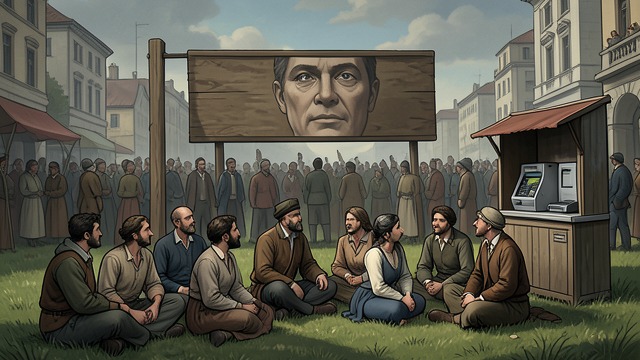
Making Discussion Civic Practice
A Proposed Holiday
James Fishkin and Bruce Ackerman proposed a national Deliberation Day before major elections. Voters would gather in small and large groups to discuss campaign issues and receive payment for participating and voting.
The plan aimed to give citizens both information and a meaningful forum, countering political disengagement and the narrowing of public debate.
Utopian or Useful
Critics such as Richard Posner doubted that Americans had the time or appetite to become deeply informed. The proposal also risked treating deliberation as if it could automatically create consensus or virtue.
The conflict is between a demanding ideal of civic participation and a skeptical view of citizens’ limited attention.
Voting Beyond Self-Interest

What Voters Want
A Market Model of Politics
Public-choice theorists applied economic reasoning to voters, politicians, and regulators, assuming that each pursued self-interest. The model explains lobbying and short-term political incentives, but it can understate principle and civic duty.
Voting itself is difficult to explain as narrow material self-interest when a single ballot is unlikely to decide an election.
Social Judgments
Studies cited in the book find voters’ choices can track their view of the national economy more than their private financial circumstances. Ideology may also predict policy attitudes better than an individual’s immediate advantage.
The chapter does not deny self-interest. It rejects the assumption that politics merely reproduces the same motivations as buying and selling.
Ignorance and Representation
What Voters Do Not Know
Facts and Attention
Polls revealed substantial public misunderstanding about foreign aid spending, taxes, and political institutions. The author accepts that most voters do not constantly study policy details.
Low knowledge of a specific fact, however, is not by itself proof that citizens cannot choose among candidates. Representative democracy creates a division of cognitive labor: officials specialize, while voters judge them by consequences.
Competition as a Check
Political competition can punish leaders when decisions have visible effects on people’s lives. Ordinary citizens also contribute local knowledge that experts may not possess.
The defense remains conditional. Voters are not omniscient, but neither are insulated elites, whose shared backgrounds may narrow the information they consider.
Democracy as a Social Settlement

Living with Disagreement
No Single Public Answer
The common good has no uncontested standard that can settle every political disagreement. Citizens and groups may sincerely advocate different policies while claiming to serve society.
Democracy therefore cannot be treated as a reliable cognition machine that reveals one objectively correct policy in every case.
Another Kind of Wisdom
Democratic practice helps people coordinate and cooperate by requiring them to accept that opponents sometimes win. Citizens continue to participate because they expect their values to remain protected and their opportunity to return to the argument to survive.
The book’s final resolution is modest but significant: democracy may not guarantee wise policies, but choosing democratic procedures helps people live together without unchecked authority.
January 2003
The early 2000s proposal before national elections
The public-choice debate introduced in chapter 12
The chapter’s evidence on voter knowledge
The book’s final pages
